My Day with Miss India
A lot has happened since I last wrote, almost all of it good. I wished for fun, and human interaction, and I’ve gotten it in spades.
Precursor: Jodhpur and Jaisalmer
First, I went from Udaipur to Jodhpur, the blue city. There, I met Yassi, a German-Sudanese tourist staying at the same Haveli as me. We visited the monumental Jodhpur fort together, chatting about our travels, politics, life in Germany and the US, and so on. It was a welcome diversion from two weeks where I’d been mostly solo.
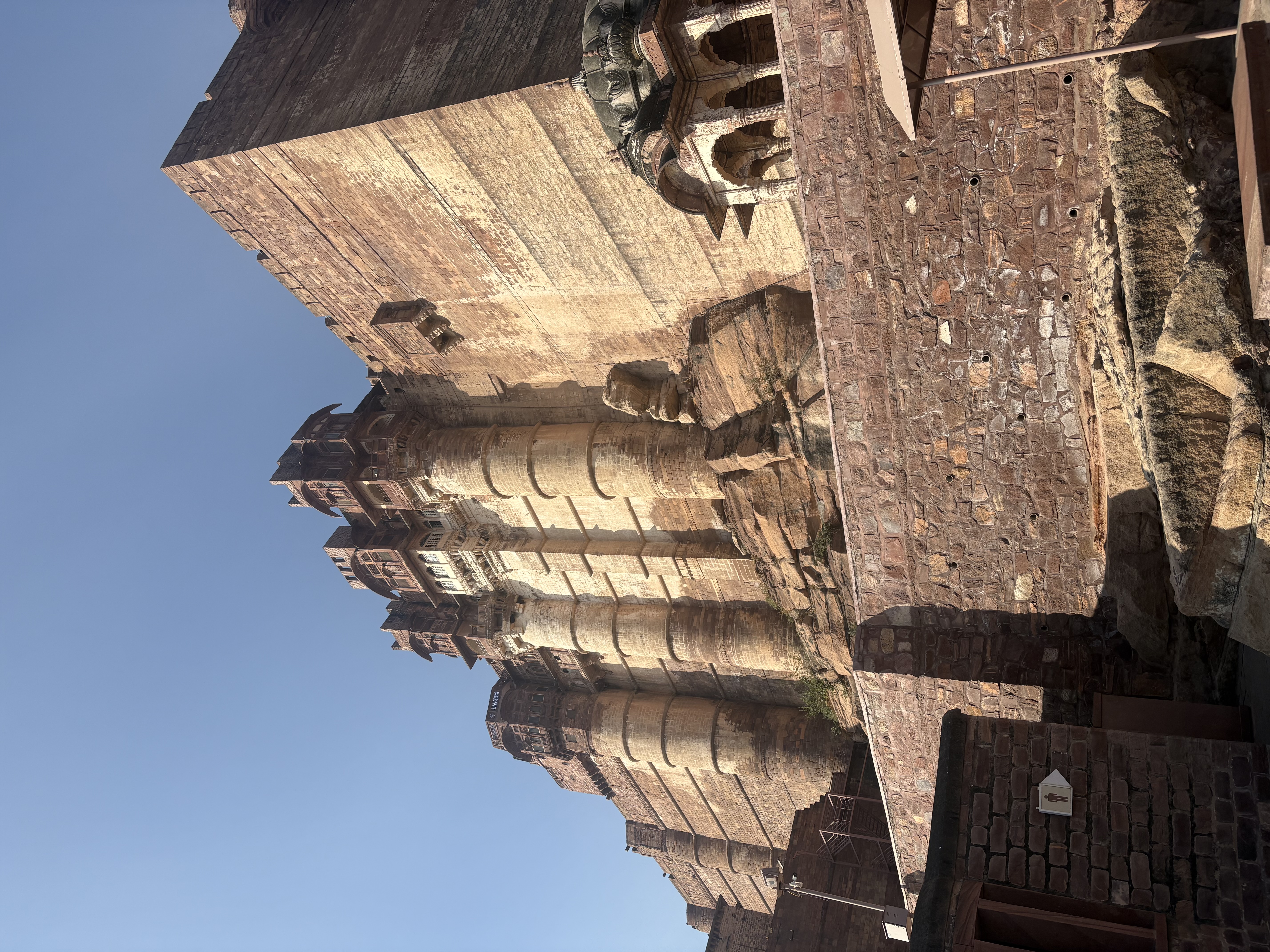
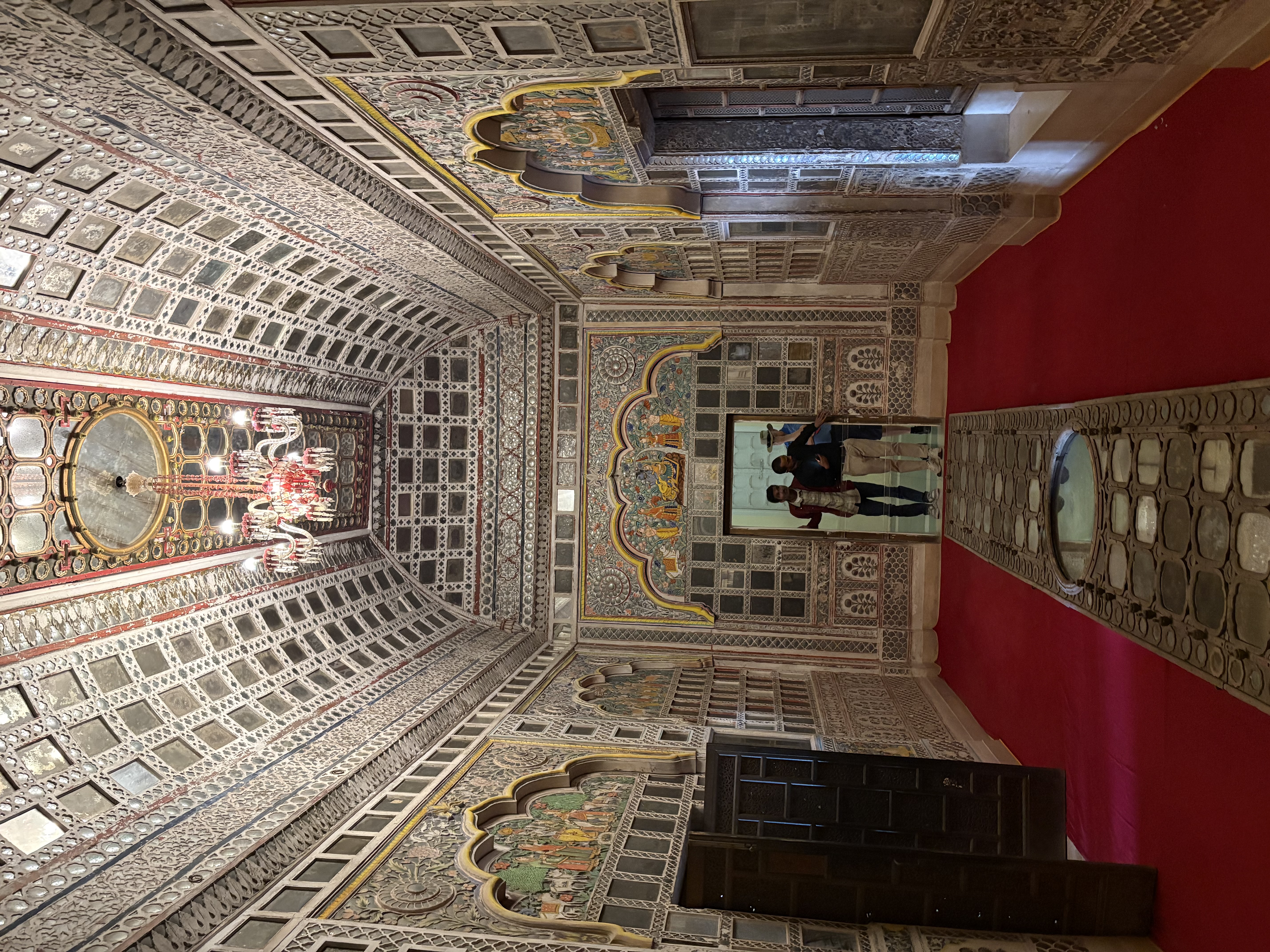
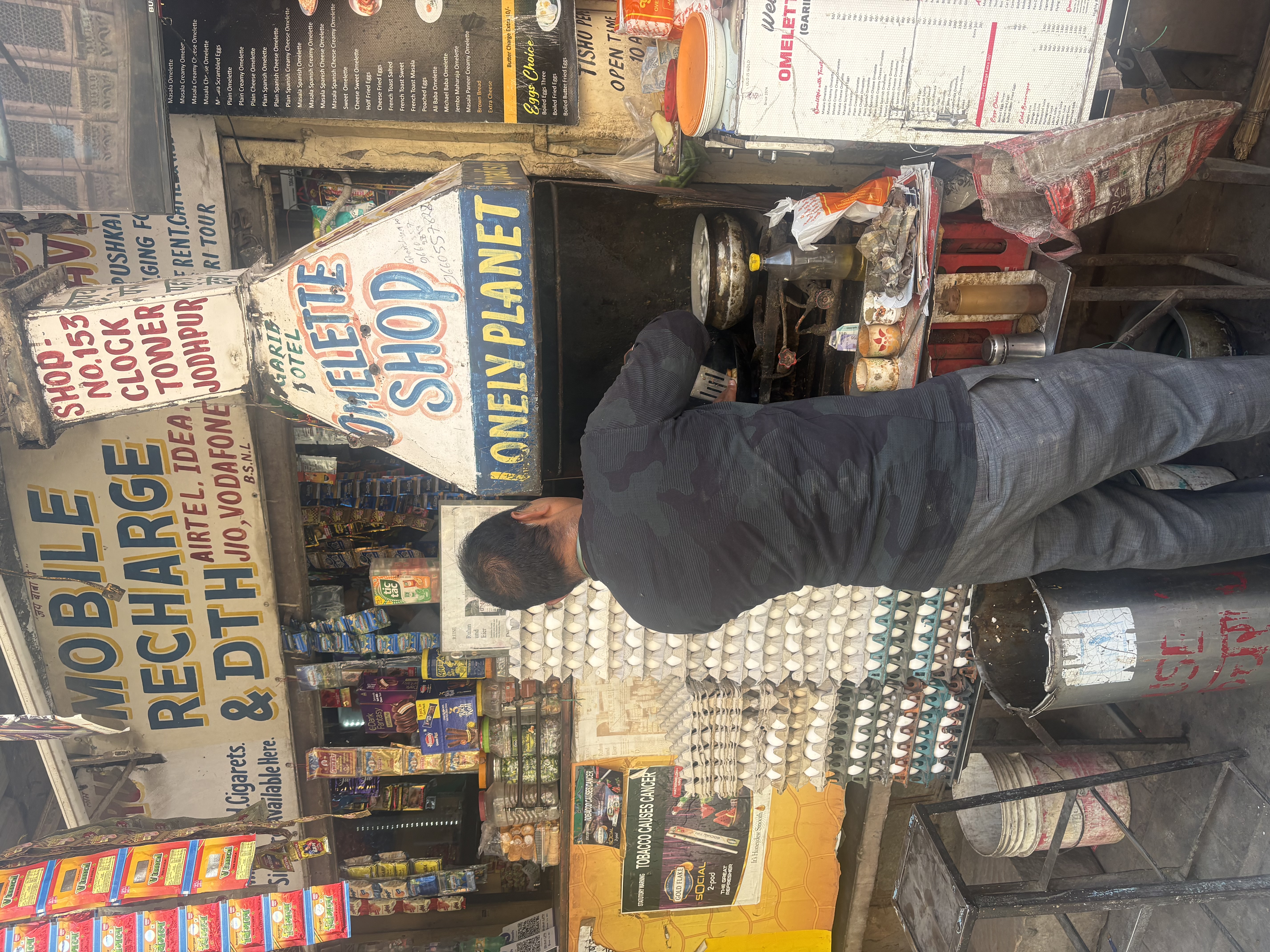
We also had an omelette for lunch which was advertised as one of the best things to eat in Jodhpur. I was left scratching my head as to why this would be the case.
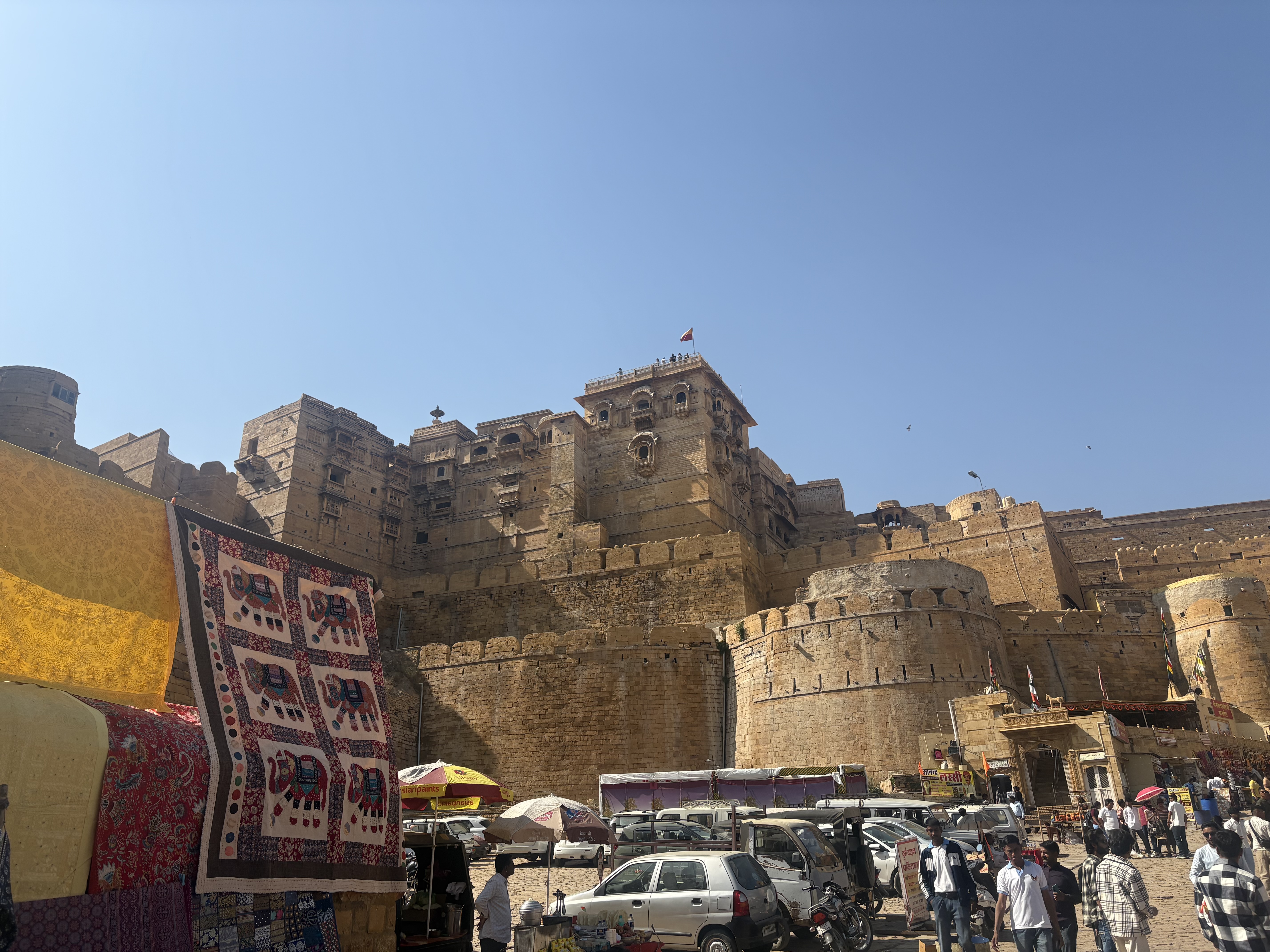
I stayed one night in Jodhpur and took a train to Jaisalmer, the yellow city, deeper in the desert. The region Jodhpur and Jaisalmer are in is called the Mewar, which apparently means “the land of death.” It is a big desert. Pretty badass.
The two overnight trains I’ve taken, one from Jaipur to Udaipur and the other from Jodhpur to Jaisalmer, were both good experiences. I was in a first-class sleeper car both times, granted, but I was surprised that I actually slept. Was the sleep high quality? No. Was it so low quality that my Oura ring didn’t even detect it as sleep? Yes. But I did sleep.
In Jaisalmer I met a woman over breakfast in the Haveli. She was a Korean American who had lived in New York City for significant time, working as an animator, but now lives in Shanghai and teaches animation and art to high school students. We waxed poetic about the decline of the arts — and maybe society in general — in the face of the general AI-ification of all things. She told me she was staying in the desert at a fancy-ish (but still fairly affordable) retreat. I was looking for a desert camp to stay at, to see the stars and ride a camel, so I was happy to join her.
After breakfast I went to walk around the city. On the walk to the Jaisalmer fort, I encountered a very tall white man (6’6”, he later told me), and we joined forces. This was Johannes, from Frankfurt. He told me that, while trained as a lawyer, he works for the German government deciding who is eligible for various benefits. We toured the old fort and an intricate Jain temple within it, and then retired for lunch at a nearby hotel. There, we talked world politics (agreeing that the EU needs to militarize sooner rather than later) and shared some fairly mediocre Rajasthani fare.
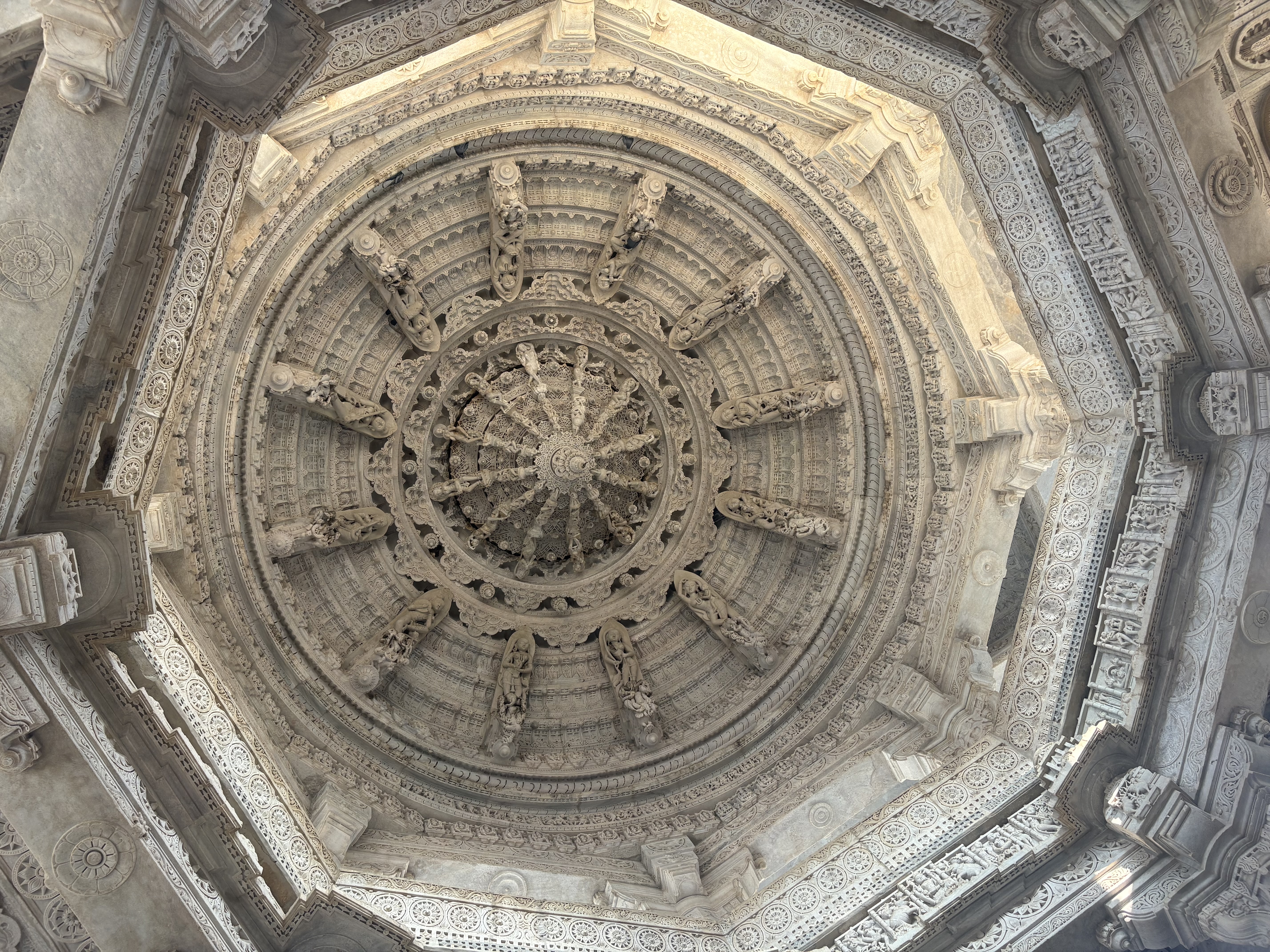
A note on Jainism: I was dimly aware of the Jains before visiting India, from a great Philip Roth novel, American Pastoral, in which the protagonist’s daughter quite comically becomes a Jain. Jainism, however, is nothing funny: it’s really a very impressive religion. Its adherents are prohibited from killing anything, including insects or germs. They cannot even eat garlic and onions, since Jains view the uprooting of vegetables as killing of germs. This is the practice of Ahimsa, or nonviolence, by which Gandhi was deeply inspired (his mother was a Jain). The Jain temple in Jaisalmer was intricate and interesting, but the one on the road from Udaipur to Jodhpur was magnificent, carved in white stone and soaring to 100-foot domes.

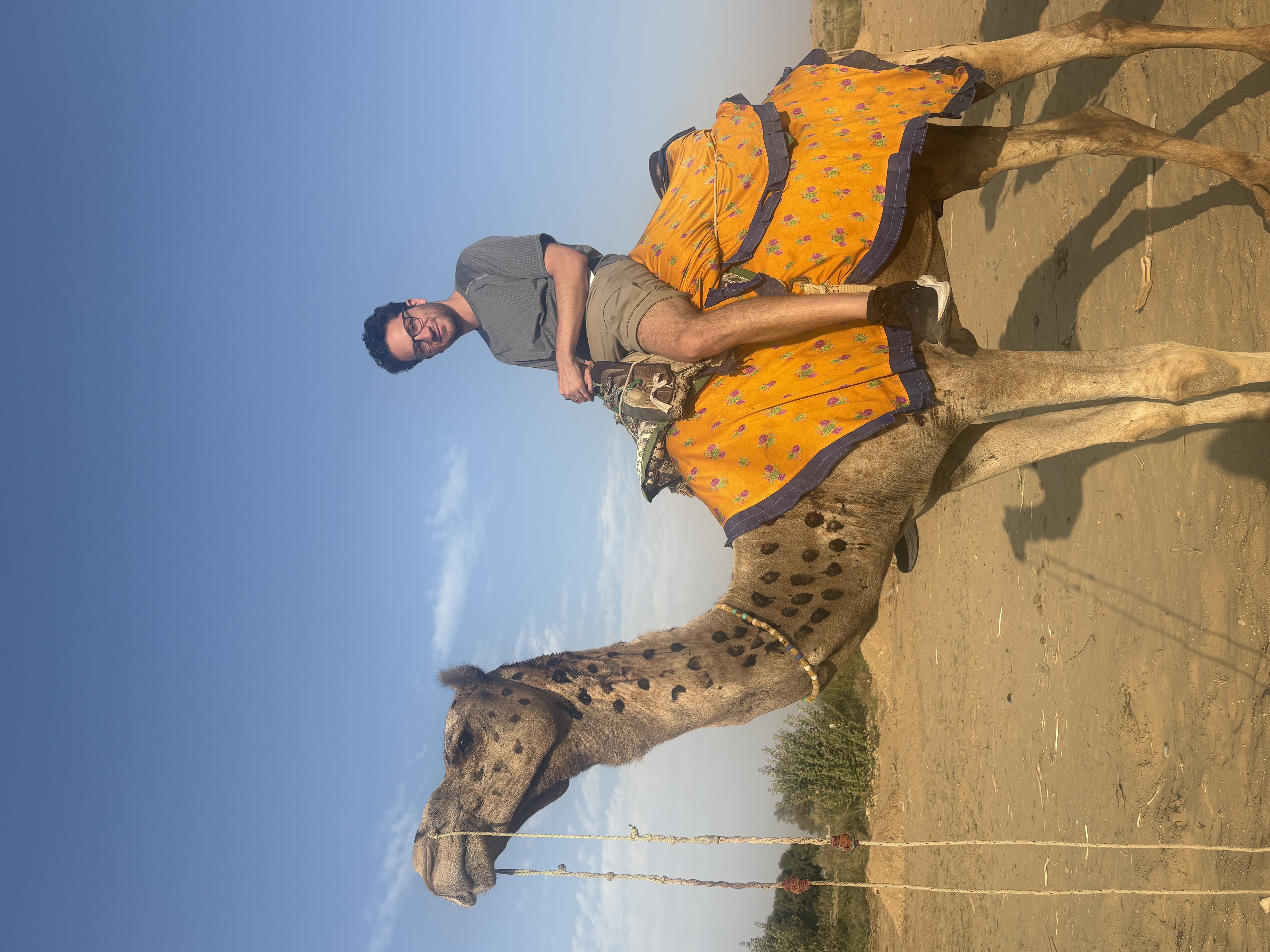
Next I went to the desert camp. The camel safari was alright — novel to ride a camel, certainly, but otherwise nothing too memorable. We just rode for 30 minutes, stopped, sat around, and rode back to camp. There was then a traditional Rajasthani dance show. After the show, some Indian guests came over and literally dragged me onto the dance floor, where the music shifted from traditional songs to Bollywood and Shakira. That was good fun.
I then went stargazing. You really can see an incredible amount of stars out in the desert. Still, even there, there was enough light from the various desert camps that we weren’t in total blackness.
The next morning I returned to Jaisalmer proper and had a quiet rest day before heading to Ahmedabad.
Ahmedabad and Miss India
At the Jaisalmer airport, waiting for my flight to Delhi and then Ahmedabad, I spotted an Australian couple doing the NY crossword. Being a sucker for the crossword, I asked to join, which they graciously allowed. We polished off a Saturday with only minimal cheating.
We had time for the crossword because the flight to Delhi was delayed. This meant that when I arrived at Delhi a man was waiting for me; he whisked me and two other passengers through security so we wouldn’t miss our connections. This is the kind of great service you can get in a country of 1.4 billion!
The other two passengers being so whisked were a Japanese woman heading to Varanasi and an Indian woman, Suman, also heading to Ahmedabad. When I told her I was going to Ahmedabad, she offered to show me around. While I remain wary of scams, I had no reason to distrust her, so I eagerly accepted this offer.
Suman told me she runs eight businesses and was coming from a wedding in Jaisalmer, where she’d acted as the MC (the word she used for this is “anchor”, but I gather that’s an “MC” in American parlance). She also has a real estate agency, and I found out later that she trades in government-approved gold and silver and makes and sells her own soap. I asked her how she had time to show me around, but she brushed it off. We agreed to meet up the next day for a tour of the sites I most wanted to see: the Gandhi Ashram and the Ahmedabad stepwell. Suman added Akshardham, a Jain temple, to the list.
By the way, a note on why I wanted to visit Ahmedabad. Ahmedabad doesn’t seem like it’s on the usual tourist circuit, although it is a city of almost 10 million. It’s home to the Ashram Gandhi founded and lived in for most of the 1920s and from where he initiated his famous “Salt March,” an act of political disobedience against the Raj’s regressive taxes on salt. I have a longstanding interest in Gandhi, as some readers will know. I listened to his autobiography years ago when I was traveling in Australia, and found it deeply inspirational: his conception of nonviolence, while of course idealistic and even impractical, is brave and noble, and Gandhi lived out his own values at the cost of his life. These days, he receives some derision for his dogmatism, for example the way in which he tested his chastity by sleeping next to nude female devotees. This isn’t something I’m going to defend except to say that Gandhi was born in the 1860s and he was of course dogmatic; this was the discipline by which he fueled his idealism. He was an imperfect human, not the saint he’s often described as, but he still exhibited tremendous courage on behalf of the Indian people. So, I mostly wanted to visit Ahmedabad to see the Gandhi Ashram.
Suman and I met the next day at her office in outer Ahmedabad, where she treated me to an Indian lunch made by her mom. Her mom then appeared, along with her brother, who works as her partner in her real estate business. Suman, her mother and I then departed for the stepwell, where we took pictures with school kids (they were excited to see a foreigner, I guess) and purchased upwards of 100 bananas to feed to the nearby monkeys and cows. The monkeys were extremely docile; I’d read that some monkeys can be dangerous, but these ones came right up to us and took the bananas from our hands.
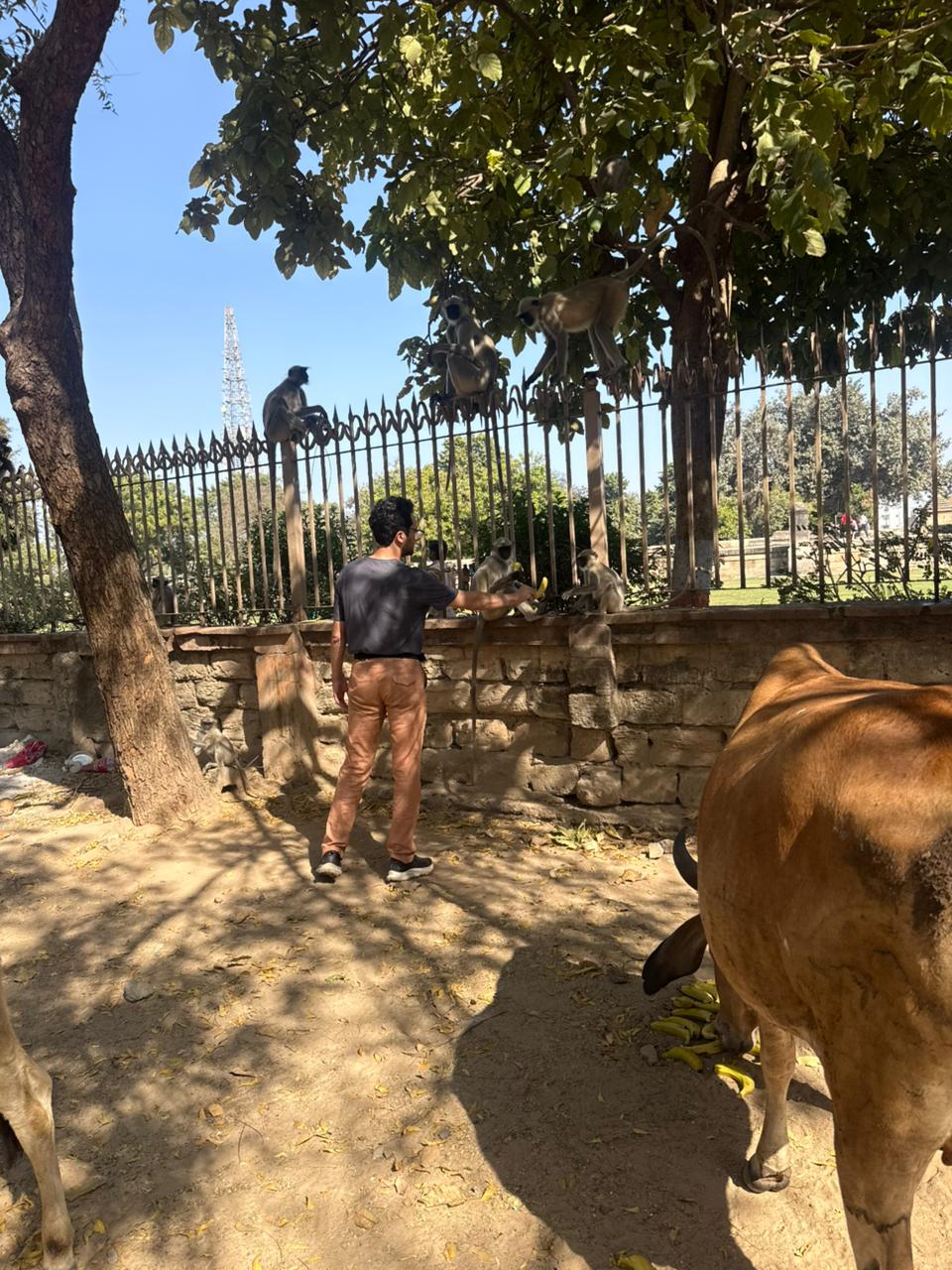
From the stepwell Suman drove to Akshardham. We stopped on the way to feed a wandering cow, and Suman told me how she always tries to feed the animals she encounters. “They don’t have money so they can’t buy their own food,” she told me. Furthermore, their owners often neglect them, leaving cows to wander the streets eating trash.
At Akshardham, we scarfed down Panipuri, a street food consisting of a thin, crispy shell filled with sweet and/or spicy liquid and soft potato. We then toured the temple, where Suman gave me a crash course in Hinduism. She said she prays especially to Hanuman, the devoted companion of Rama and Sita. She asked if I pray; when I said no, she followed up with “how do you live?” Somehow I get by!
We then ate more: dipping a yellow bread-like carb in a sweet yellow daal (perhaps the best daal I’ve ever had) and scooping up chickpeas with handfuls of cholle. I downed a pistachio lassi, a specialty of the region. We were then off to the Gandhi Ashram.
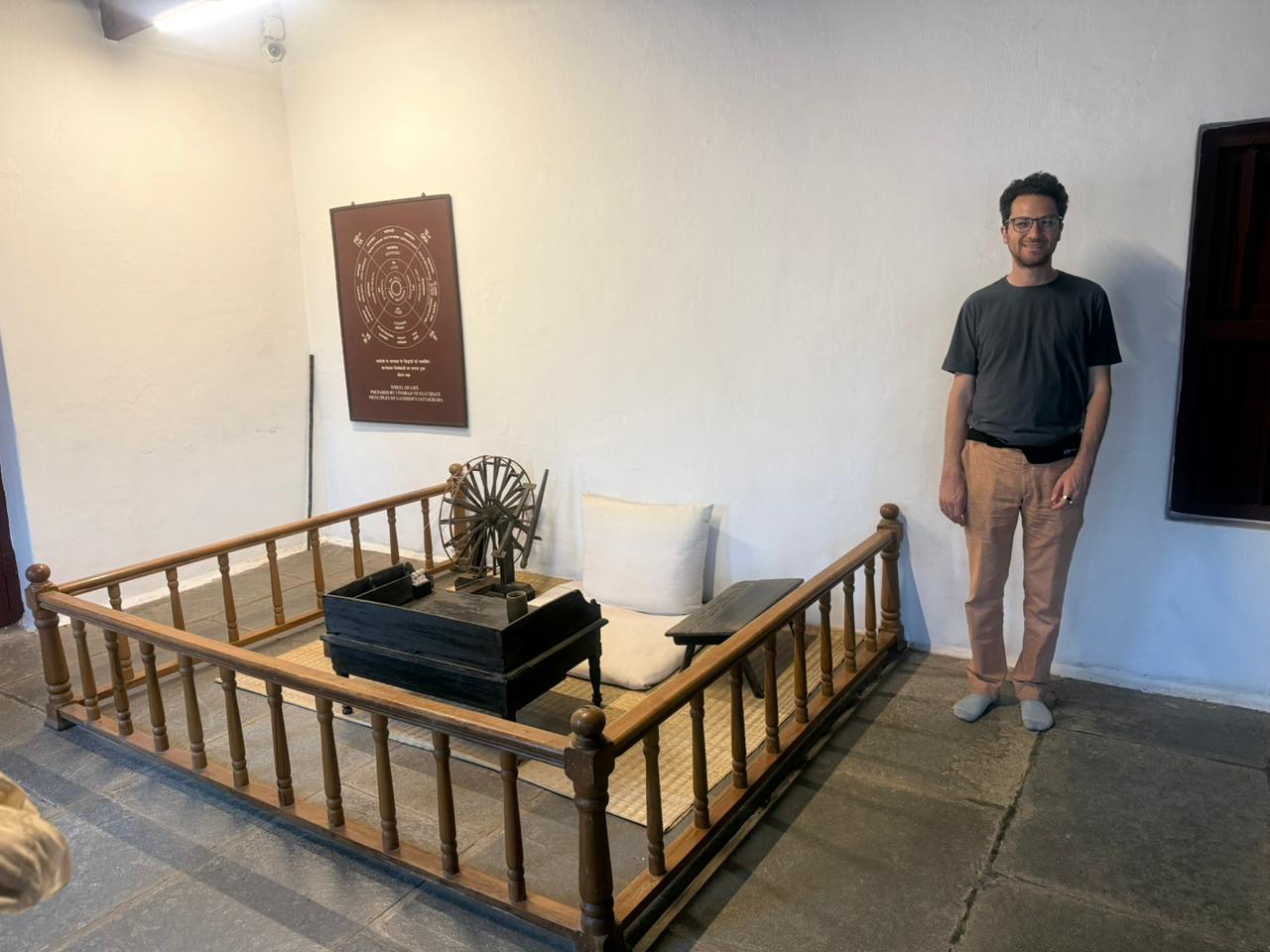
Unfortunately, we got to the Ashram not long before its closing, so I couldn’t see everything I wanted to, though I did see a lot. Mostly, I read about the place: about the people who had lived there, what life was like. Gandhi had imposed strict rules: celibacy, controlled diet (no spices!), daily prayer. All of this was meant to enable Satyagraha, or “soul force”: political disobedience in which a person does not comply with unjust laws, no matter the consequence to their self, including unto death and torture. Does one need to give up spices in order to practice noncooperation? It seems a bit silly on the surface, but I can see the argument that in order to be able to sacrifice oneself for a cause, you must first purge yourself of connections to the material world. I think of the lines from Yeats:
Hearts with one purpose alone Through summer and winter seem Enchanted to a stone To trouble the living stream.
Those who are fighting for something — Indian or Irish freedom, say — become unnaturally hardened, unable to partake in the bounty of nature (the “living stream”). That’s a different perspective from Gandhi: for Yeats, it’s a tragedy that some must fight against human nature in order to fight for justice, whereas for Gandhi, human nature is a distraction from the fight for justice. Two sides of the same coin, perhaps.
Suman, separately, shared with me her view of “Gandhiji”: she had lost much respect for him, she said, viewing him as largely responsible for Partition. I know Gandhi supported Partition, but I had always thought he did so grudgingly and had little choice. Either way, some blame must surely be apportioned to him as India’s preeminent leader at that time. But is it fair to blame him more than the British or separatist politicians like Muhammad Ali Jinnah?
Gandhi’s vision of Hindu-Muslim unity seems more precarious than ever today. Suman told me about terrorist attacks in Kashmir, where Islamist fanatics funded by Pakistan massacred Hindu honeymooners. Each couple was asked their name; if they gave a Hindu name, the husband was shot. Some women were sold at a slave market. It is impossible, hearing this, to begrudge anyone for no longer sharing Gandhi’s idealism. (However, note that I am only sharing my reaction to what Suman told me here; I’d imagine actual research would show this issue is a lot more complex than she makes it seem.)
My view at this point is that the ideals of Gandhi are correct on some deep level: could we live in the way he lived, putting “the truth” before all else, the world would be a much better place. We’d escape the tragedy of the commons, and live in real brother (and sister) hood. But alas — to put my Christian hat on for a second, though I’m nominally Jewish, and actually non-religious — we live in a fallen state. Perhaps some of us can be as enlightened as Gandhi was, but most of us cannot (myself included!). We cannot ask people to put their lives on the line like that. Most of us are part of the “living stream,” for better or worse.
Anyway, this post isn’t supposed to bore you with philosophy!
Leaving the Ashram, Suman took me aside and told me she has two great loves: helping animals, which she does through her foundation, and earning money. She revealed that she was crowned Miss India in 2018.
I have to admit — I’m sorry Suman if you’re reading this — I already knew that she’d been crowned Miss India, since I’d googled her the morning before we met up. Though I had no reason to be suspicious, I’d been burned enough times in India that I figured a quick search wouldn’t hurt. Of course, everything checked out. I’m a little ashamed by my lack of trust, which is perhaps why I didn’t come clean to Suman when she told me about her Miss India victory.
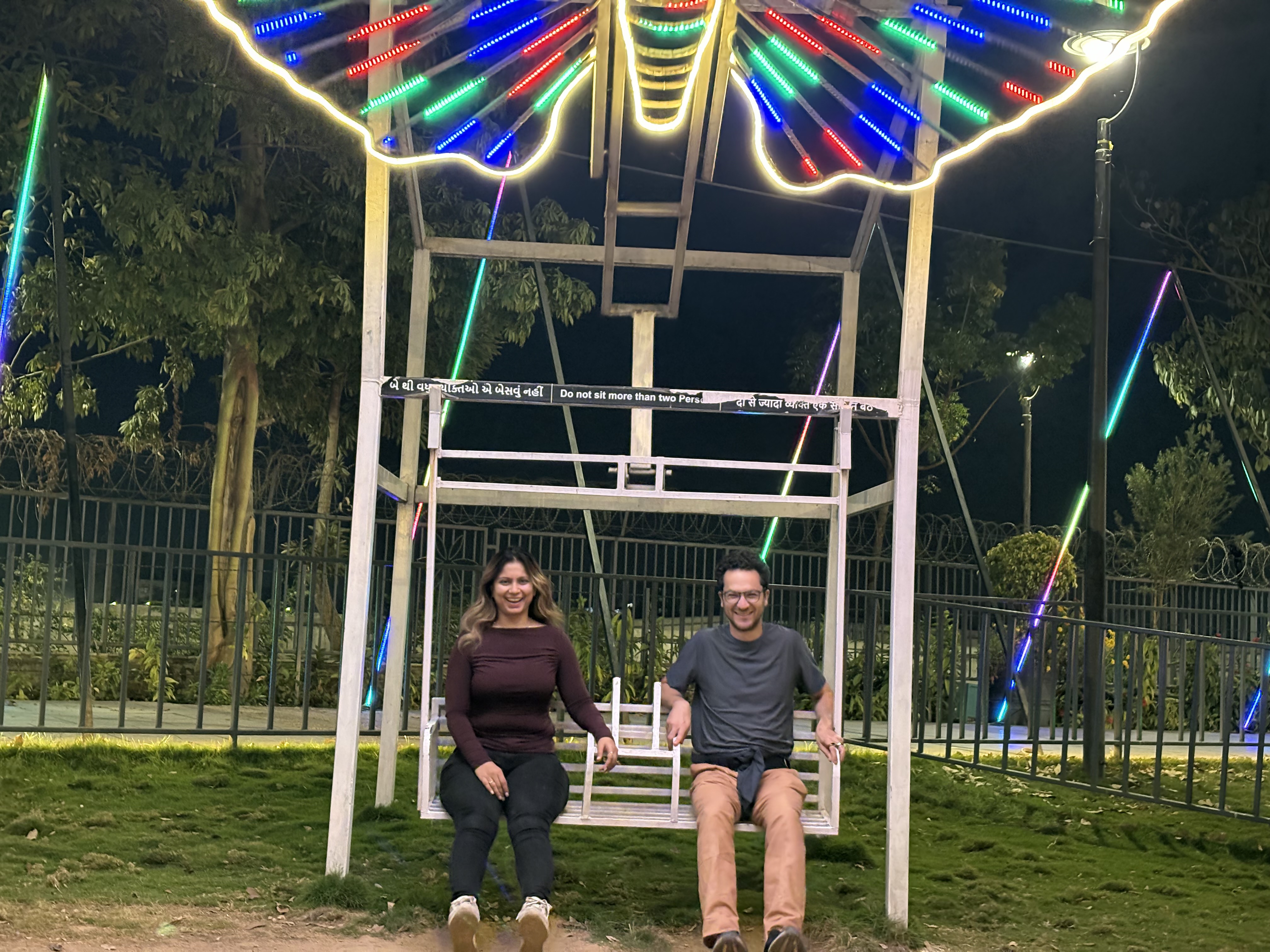
From the Ashram we drove to the Atal Bridge, a new pedestrian bridge spanning Ahmedabad’s Sabarmati river. On the way, we stopped at a new pop-up market where Suman bought an incense holder, a dress for an idol, and some snacks. We then walked the bridge, talking about Indian politics, and pushed Suman’s mother through the nearby garden walkway in a wheelchair as she had gotten tired. The garden was illuminated by neon lights, full of glowing plastic zebras, bears and lions, all animals native to India. We sat under a butterfly swing and had our picture taken. It was a much more modern India than I’d seen so far — one perhaps less romantic to us westerners but understandably more appealing to many locals than the dusty, chaotic streets of India’s old cities.
Suman and her mother then very kindly dropped me off as close as possible to my hotel, since cars are not allowed in the old city, and I caught a few hours of sleep before catching an early flight to Bombay.
Meeting Suman and her family was incredibly lucky for me. Because of her generosity, I had one of the most interesting days I’ve had in India so far. My perspective feels broadened and I have memories that will stay with me for a long time. Suman and family, you are welcome in New York — or wherever I am — anytime!