Maximum City
I left Bombay two days ago, but I am only now finishing Maximum City (written in 2004 by Suketu Mehta), a massive nonfiction jaunt through India’s most iconic city.
It’s interesting to read about a city while you’re in it. Some of the places called out in the book, I had been to. Specifically, the author himself grows up on, and returns to live in, a home in Nepean Sea Road, now renamed to Lady Laxmibai Jagmohandas Marg (but still usually referred to by its British name). Nepean Sea Road is one of the poshest roads in Bombay, in Malabar Hill, one of the poshest neighborhoods in Bombay. In fact, in the book, Nepean Sea Road is a metonym for wealth:
Girish’s brother Dharmendra has a first-class season pass. But when the train is really crowded he’ll go for the second-class coaches. ‘In second class they are more flexible. First class, you’ll have some Nepean Sea Road type. He won’t move, he’ll stand where he is.’
It’s no coincidence that the author lives on Nepean Sea Road: Mehta doesn’t explicitly say so, but clearly his family, a family of diamond merchants, is wealthy, and that’s why he was able to grow up in Malabar Hills and New York City. He exemplifies many of the attitudes of India’s upper class: secularism, cosmopolitanism, intellectualism. He makes forays into the underbelly of Bombay, interviewing murderers, bar dancers and slum-dwellers. It’s a far cry from Shantaram, with its rosy portrayal of the city: for Mehta, Bombay is overcrowded, decaying, dysfunctional. But he’s also attuned to the hopefulness of millions living side-by-side, crushed together: even if they erupt into horrific violence now and then, they also take care of each other in small ways. An aspiring poet, homeless, sleeps beside a man he’s never met every night (the man goes to bed after the poet and gets up before he does). Strangers lift stragglers onto departing trains, knowing that a missed train can sink a career. A hardened gangster and slum-dweller admits he’s never slept alone in his life.
Mehta floats above it all, ejecting from his underworld digging when things get a bit too real. We, as readers, are permitted a voyeur’s look along with him, and it leaves us feeling a little gross: are we as Western readers just as implicated as Mehta is, parachuting in and out of atrocity? The answer seems to be yes. Much of the West is Malabar Hills.
Which is why it’s perhaps fitting that I had dinner on Nepean Sea Road with my mom, one of her clients, who is from Bombay, his brother, and his great-nephew. The brother is a notable figure: an architect who designed over one hundred buildings spanning multiple countries, including government buildings and luxury hotels. His house, as one might expect, was gorgeous: all marble, with tasteful painting and sculpture from around the world, and opening onto a large terrace with a view of the sea. It’s telling how just by being upper-middle class in the states — the son of a lawyer — I was able to parachute into the Bombay upper class, into a home nicer than that 99% of Mumbaikars live in.
To be crystal clear, this blog post is not intended as a critique of people like Mehta, my mother’s client and his family, or even well-off Westerners like myself. Indeed, many well-off people I’ve met in my travels are extremely generous, both with me and their communities. I am rather commenting on the broader structural issues I‘ve noticed when traveling, particularly around how populism emerges as a reaction to neoliberal excess. (In the case of India, Congress’ corruption gave rise to the BJP; whereas in the US the 2008 financial crisis gave rise to Trumpism. Both these phenomena are downstream of globalization, I suspect.)
Of course, Maximum City was written over 20 years ago. Much has changed, and Bombay seems a more functional, hopeful city than the place Mehta describes. The train when I rode it was crowded, yes, but no worse than the New York subway at certain hours. Poverty was bad, sure, but as I wrote elsewhere many slum-dwellers are just waiting for new towers to be erected over their slum, so they’ll be grandfathered into a unit. I didn’t hear a peep about the mafia, with which Maximum City is preoccupied: perhaps they’re not as powerful as they once were.
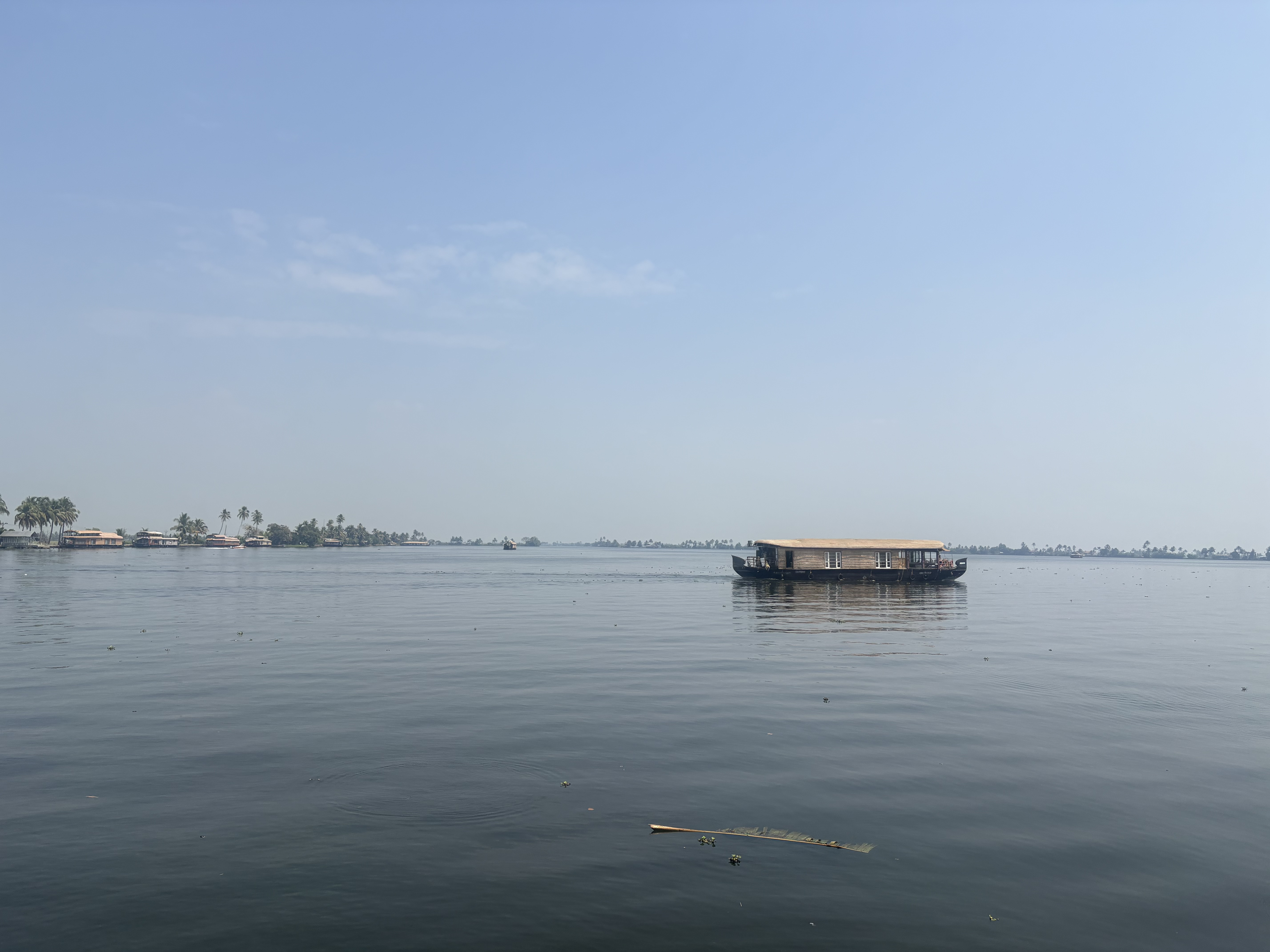
I am now in Kerala, cruising on the Alleppey Backwaters in a houseboat where I will spend the night. In a way, the poverty seems more crushing here: whereas in Bombay, there is a sense of motion and upward-mobility, here I am aboard a boat where the crew hardly speaks English, and where much of their pay is likely appropriated by the English-speaking intermediaries who organized this voyage. “They’re village people,” one intermediary said as he was showing us around the boat, to explain why the crew doesn’t speak English. The gap between the haves and have-nots persists.
Mehta writes about a rich diamond merchant who gives away all his worldly possessions in an ornate ceremony to embrace a life of asceticism, traveling the roads by foot, begging:
More than anybody else I know, he lives with a daily nagging realization of the amount of violence our species perpetrates, each hour, each minute, not only on our fellow humans but on all life and on creation itself.
And yet what a horrible renunciation, to live a life without joy to avoid causing pain. The merchant is separated from his loved ones, never again allowed see his wife and daughter (who also become ascetics) lest they become objects of his lust. If this is the vision of an enlightened humanity, give me barbarism. There must be some middle way between the destruction of others and the destruction of oneself.
For Mehta, that middle way is in the way people interact with each other, each separate and in unison, pursuing their own task as part of Yeats’ “living stream”:
Each person is the end product of an exquisitely refined specialization and has a particular task to perform, no less and no more important than that of any other of the six billion components of the organism. It is a terrifying image. It makes me feel crushed, it eliminates my sense of self, but it is ultimately comforting because it is such a lovely vision of belonging.
Comforting, yes. True? Just? I’m not sure. If everyone has their own particular task, all of which are equally important, what is our obligation towards each other? What do those of us from Nepean Sea Road or Berkeley, California owe those in a Bombay slum? And what are we owed by the elites above us? Anything? Nothing?
Maximum City also documents what happens when the elites don’t satisfy their obligation towards the underclasses. This is what Mehta blames for the rise of the Shiv Sena and BJP, both Hindu nationalist parties that are anathema to Bombay’s traditional upper class:
When people in south Bombay mourn the loss of the ‘gracious’ city, what they are really mourning is the loss of their own consequence in the city’s affairs. It was never a gracious city for those who had to live under the shadow of the rich man’s mansions; it was actively pestilential. It will take them a few generations, the new owners, to learn how to run their house and keep it clean and safe. But how can we begrudge them that when we, who had been the owners for such a long time and had still botched it, handed it over in such terrible disrepair?
I can’t help but think of Trumpism in the US when I read this. It is largely mismanagement by the elites that creates an opportunity for populist movements to catapult themselves to power. No 2008 financial crisis, no Trump, I’d wager. Mehta’s intuition that populist movements will eventually morph into responsible governments seems reasonably well-founded with respect to India. In the US, things are far less clear. Our situation is different — we’re starting at the top, not near the bottom of the pack. It’s a long way down.
#India #Travel #Literature #Politics